top
Exodus 40 - The presence of the LORD.
One year after leaving Egypt, the tabernacle is completed. A trip that could have taken them two to three weeks had now taken a year. Little did the Israelites know, it would take thirty nine more years because of their persistent lack of trust and faith in a God that they could see every day!
Exodus 40:34 Then the cloud covered the Tabernacle, and the glorious presence of the LORD filled it.
Exodus 40:38 The cloud of the LORD rested on the Tabernacle during the day, and at night there was fire in the cloud so all the people of Israel could see it. This continued throughout all their journeys.
Hopefully we are not this dense.
Father, please give us willing hearts so that we get it right the first time, so that we don't have to spend 40 years of wandering.
Exodus 39 - Blessed because...!
Exodus 39:32 And so at last the Tabernacle was finished. The Israelites had done everything just as the LORD had commanded Moses.
Exodus 39:42-43 So the people of Israel followed all of the LORD's instructions to Moses. Moses inspected all their work and blessed them because it had been done as the LORD had commanded him.
They did everything just as the LORD had commanded. How many of us try to do it our way? Why were the people blessed by Moses? Because it had been done as the LORD had commanded.
Father God, please give us hearts that are willing to do as You have commanded.
Exodus 37 and 38 - Precious
Exodus 37:24 The entire lampstand, along with its accessories, was made from seventy-five pounds of pure gold.
Exodus 38:24 The people brought gifts of gold totaling about 2,200 pounds...
Exodus 38:25 The amount of silver that was given was about 7,545 pounds...
Exodus 38:29 The people also brought 5,310 pounds of bronze...
I find it hard to imagine how much gold, silver, bronze, cloth, and other precious stones and costly material was used in the construction of God's temple. The numbers are amazing! And all of it was donated. The women even donated their mirrors, which were used for the bronze wash basin! Are we that generous when it comes to things that we have that could be used for God's service? How about our talents?
Lord, please give us willing hearts.
Exodus 35 and 36 - Invitation and Abundance
Moses invites the people to bring gifts for the building of the tabernacle.
Exodus 35:5-9 Everyone is invited to bring these offerings to the LORD: gold, silver, and bronze; blue, purple, and scarlet yarn; fine linen; goat hair for cloth; tanned ram skins and fine goatskin leather; acacia wood; olive oil for the lamps; spices for the anointing oil and the fragrant incense; onyx stones, and other stones to be set in the ephod and the chestpiece.
They were not commanded, they were invited. God loves a cheerful giver. He wants to bless us. Giving should be a joyful experience, not another tedious unwanted task or commandment to keep.
Exodus 36:3-7 Moses gave them (the craftsmen) the materials donated by the people for the completion of the sanctuary. Additional gifts were brought each morning. But finally the craftsmen left their work to meet with Moses. "We have more than enough materials on hand now to complete the job the LORD has given us to do!" they exclaimed. So Moses gave the command, and this message was sent throughout the camp: "Bring no more materials! You have already given more than enough." So the people stopped bringing their offerings. Their contributions were more than enough to complete the whole project.
The people willingly brought so much that they had to be asked to stop. There was more than enough to complete the work.
It is such a shame that our pastors have to beg us to give what we should be giving already. Everything we have is God's. He just allows us to manage it. If everyone that were a member of a church gave their ten percent (tithe) without being asked there would be more than enough money to run the local churches and feed every homeless person on the planet. As it is, the average person gives only about $20 per month. I don't know about you, but I make a bit more than $200 per month in income. Let's stop robbing God of the tithe, and ourselves of His blessings.
Exodus 34 - Chernobyl experience.
It is said that there is a forest in the area near the Chernobyl nuclear reactor site that glows at night due to all of the radiation that it absorbed. If I personally saw it, I know that I would be quite freaked out. So look at this section of scripture.
Exodus 34:29-30 When Moses came down the mountain carrying the stone tablets inscribed with the terms of the covenant, he wasn't aware that his face glowed because he had spoken to the LORD face to face. And when Aaron and the people of Israel saw the radiance of Moses' face, they were afraid to come near him.
Then Moses covered his face with a veil until he went into the tent to meet with God, covering it back up when he came out.
What an amazing constant reminder that God was present with Moses and the Israelites. All they had to do was look at his face and they would know that everything they had heard was true.
Exodus 33 - Friend to Friend.
This statement about Moses is one that brings about the most soul-searching for me. I find it hauntingly compelling - appealing. I long for it.
Exodus 33:11 The Lord would speak to Moses face to face, as a man speaks with his friend...
Exodus 33:17 And the LORD replied to Moses, "I will indeed do what you have asked, for you have found favor with me, and you are my friend."
Can God truly count me as one of His friends? Would He be willing and able to do so?
How about you?
Exodus 32 - Aaron the weasel
I find here an appalling lack of faith on the part of Aaron. But I was not in his sandals. Perhaps I would have done even worse. However, look at this progression of scripture.
Exodus 32:1-5 ...they gathered around Aaron and said, "Come, make us gods who will go before us.... Aaron answered them, "Take off the gold earrings that your wives, your sons and your daughters are wearing, and bring them to me." ...He took what they handed him and made it into an idol cast in the shape of a calf, fashioning it with a tool. Then they said, "These are your gods, O Israel, who brought you up out of Egypt." When Aaron saw this, he built an altar in front of the calf...
Moses comes back down - ticked off, and breaks the tablets of the law that God Himself had made. Then he confronts Aaron - his brother.
Exodus 32:21-25 He (Moses) said to Aaron, "What did these people do to you, that you led them into such great sin?" "Do not be angry, my lord," Aaron answered. "You know how prone these people are to evil. They said to me, 'Make us gods who will go before us... So I told them, 'Whoever has any gold jewelry, take it off.' Then they gave me the gold, and I threw it into the fire, and out came this calf!" Moses saw that the people were running wild and that Aaron had let them get out of control and so become a laughingstock to their enemies.
Aaron asked them to bring the gold, he cast the calf shape and fashioned it with a tool, built an altar to it. Then he lies to Moses and says "I threw the gold into the fire and this calf popped out."
I think that this is a point where nepotism played some role. Had this not been a relative, I suspect that Aaron would have been killed on the spot. But in a true show of mercy and grace Aaron was restored to his exalted position as priest of God.
Exodus 31 - Grandson of Hur
It is interesting to note how blessed the family of Amram and Jochabed were. Moses' sister Miriam married Hur - Moses' left-hand man. He is the grandfather of Bezalel, who is described in this section of scripture.
Exodus 31:1-5 Then the Lord said to Moses, "See, I have chosen Bezalel son of Uri, the son of Hur, of the tribe of Judah, and I have filled him with the Spirit of God, with skill, ability and knowledge in all kinds of crafts-- to make artistic designs for work in gold, silver and bronze, to cut and set stones, to work in wood, and to engage in all kinds of craftsmanship.
Exodus 30 - Taxation
Hmm, God instituted a Flat Tax among the Israelites.
Exodus 30:14-15 All who cross over, those twenty years old or more, are to give an offering to the Lord. The rich are not to give more than a half shekel and the poor are not to give less when you make the offering to the Lord to atone for your lives.
Everyone was to pay the same amount, rich or poor. However, this is not a representation of taxation. It is a representation of the fact that all sin is equal in God's eyes. Therefore the price, or penalty is the same no matter who you are.
Exodus 29 - Garments and Consecrated.
Exodus 29:29-30 "Aaron's sacred garments will belong to his descendants so that they can be anointed and ordained in them. The son who succeeds him as priest and comes to the Tent of Meeting to minister in the Holy Place is to wear them seven days.
I wonder how long those original sacred garments survived? Imagine being the 20th in line of succession on the day that you were to be ordained. You would actually wear the same clothes that the very first person to hold your office held. Way too cool!
In verse 44 I see God giving a proviso, a "this will happen so that something else will occur" moment.
Exodus 29:44-45 "So I will consecrate the Tent of Meeting and the altar and will consecrate Aaron and his sons to serve me as priests. Then I will dwell among the Israelites and be their God.
God told them that first He would consecrate everything, then He would dwell among them and be their God.
Exodus 28 - Set Apart.
In our Western culture we tend very much toward being a classless society. What that means is that we attempt to define, designate, and treat all people as equals - no matter their rank, age, position, or occupation. But in reading today's chapter, I realized that God himself instituted classes of people.
Exodus 28:1-3 "Your brother, Aaron, and his sons, Nadab, Abihu, Eleazar, and Ithamar, will be set apart from the common people. They will be my priests and will minister to me. Make special clothing for Aaron to show his separation to God – beautiful garments that will lend dignity to his work. Instruct all those who have special skills as tailors to make the garments that will set Aaron apart from everyone else, so he may serve me as a priest.
In Exodus 21, God talks about treatment of slaves. In this chapter I see God describing those that serve Him as being "set apart from the common people". The word for "set apart" is most often translated as holy. So I see three classes of people; Holy, Common, and Slaves.
What does that mean for me? Well, frankly it grates my personality. I tend to treat everyone the same. Let me clarify and say that I do show proper deference to people's office, or position in life, such as boss, pastor, teacher and so on. But I don't consider them any better or worse than myself. However, I see God saying that those that serve in the office of the priesthood are special, they are better than the common people, of which I am one. (I know, I know, we are all a royal priesthood, a holy nation... in Christ Jesus.) But I see a principle for life being demonstrated in this section of scripture that is causing me to reevaluate how much deference and respect I should be showing to those that have an office or position in life that is loftier than mine. I don't have the answers, but it is causing the wheels in my brain to spin.
Heavenly Father, please grant me the grace to treat everyone in a way that is pleasing to You, no matter if they are in a loftier or lesser position in life than mine. I ask for Your wisdom. If indeed we are now Your Royal Priesthood Lord (1 Peter 2:9), please allow me to live in a way that engenders the respect for You that should come with that title. Amen.
Live holy! Jan
Click to go to the top
Exodus 27 - Keep it burning.
At the end of a long list of specifications comes a command and the establishment of one of the priestly duties.
Exodus 27:20-21 "Now, order the Israelites to bring you pure, clear olive oil for light so that the lamps can be kept burning. In the Tent of Meeting, the area outside the curtain that veils The Testimony, Aaron and his sons will keep this light burning from evening until morning before God. This is to be a permanent practice down through the generations for Israelites.
The practical application of this is that the tent of meeting has no windows. Thus it would have been very dark and required lamp-light. What I find interesting is that God, knowing human nature, commanded that the lamps be tended at night by Aaron and his descendants. During that day, it would make sense that you'd want light in a room if you should need to enter. At night however, people are usually asleep and there is no need for light. God however is a God of light, so He commanded that the lamps be tended at night so that they would not go out and there would always be light in His tabernacle.
The spiritual implication is that we are the light of the world and our light should never go out.
Keep it shining, Jan
Click to go to the top
Exodus 26 - God of detail.
The previous chapter began the mind-numbing details about constructing things like the Ark of the Covenant, the Tabernacle, the Lamp stands and so on. I'm sure that there is all sorts of symbolism woven into the narrative. I'm sure that the colors and numbers of the items mean something. But frankly it escapes me.
What I do see is that God is a God of detail. He cares about the minutiae. And if He cares about the details of inanimate stuff, He must care a whole lot more about the details of my life.
Therefore it is comforting to me to read about making the tabernacle with ten curtains of finely twisted linen and blue, purple and scarlet yarn, with cherubim worked into them by a skilled craftsman... It is comforting because I know that God notices and He cares.
In His care, Jan
Click to go to the top
Exodus 25 - The Ark of the Covenant
Exodus 25:10 "Have them make a chest of acacia wood--two and a half cubits long, a cubit and a half wide, and a cubit and a half high. 11 Overlay it with pure gold, both inside and out, and make a gold molding around it. 12 Cast four gold rings for it and fasten them to its four feet, with two rings on one side and two rings on the other. 13 Then make poles of acacia wood and overlay them with gold. 14 Insert the poles into the rings on the sides of the chest to carry it. 15 The poles are to remain in the rings of this ark; they are not to be removed. 16 Then put in the ark the Testimony, which I will give you. 17 "Make an atonement cover of pure gold--two and a half cubits long and a cubit and a half wide. 18 And make two cherubim out of hammered gold at the ends of the cover. 19 Make one cherub on one end and the second cherub on the other; make the cherubim of one piece with the cover, at the two ends. 20 The cherubim are to have their wings spread upward, overshadowing the cover with them. The cherubim are to face each other, looking toward the cover. 21 Place the cover on top of the ark and put in the ark the Testimony, which I will give you. 22 There, above the cover between the two cherubim that are over the ark of the Testimony, I will meet with you and give you all my commands for the Israelites.
I found two things to personal interest here. The first being the method of handling the Ark itself. God commanded that it be carried on two poles that were placed through solid gold rings. Being of an engineering mind, I couldn't see how gold could support that much weight. The Ark probably weighed close to 2000 pounds! Pure gold is quite soft. Of course pure in those days might have been what we consider 14 karat, but still, those rings could not have supported that kind of weight. I stumbled upon the following picture that I think answers the question of how?
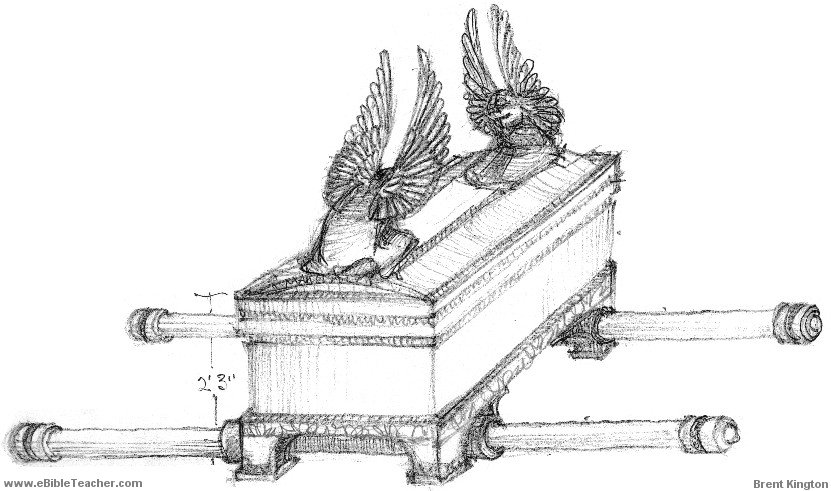
If the poles were inserted under the bottom of the Ark through the rings, the Ark would be much more stable when carried, and the weight of the structure would be supported on the poles rather than by the rings. The rings would serve to keep the poles in place, to prevent them from sliding along the bottom. Weight problem solved, except of course for the fact that the people carrying it must have been very strong!
The other thing I found interesting was the command to never remove the poles from the rings. I don't have a theological insight here, I just find it interesting.
Blessings to you. Jan
Click to go to the top
Exodus 24 - Picnic with God
OK, what happened to "no man can see God and live?"
Exodus 24:9-11 Then Moses, Aaron, Nadab, Abihu, and seventy of the leaders of Israel went up the mountain. There they saw the God of Israel. Under his feet there seemed to be a pavement of brilliant sapphire, as clear as the heavens. And though Israel's leaders saw God, he did not destroy them. In fact, they shared a meal together in God's presence!
Wow! Can you imagine that? God allows you to come up and see HIM. And then He has a meal with you, or you get to have one in His presence depending on the translation. Either way, what an amazing scene this must have been!
Praise God that we too get to one day see Him, and enjoy a meal with Him.
Revelation 19:9 And he said to me, Write, Blessed are they which are called unto the marriage supper of the Lamb...
You are blessed! Jan
Click to go to the top
Exodus 23 - Don't tick him off.
In the middle of this chapter there are a few intriguing verses.
Exodus 23:20-23 "Now get yourselves ready. I'm sending my Angel ahead of you to guard you in your travels, to lead you to the place that I've prepared. Pay close attention to him. Obey him. Don't go against him. He won't put up with your rebellions because he's acting on my authority. But if you obey him and do everything I tell you, I'll be an enemy to your enemies, I'll fight those who fight you. When my Angel goes ahead of you and leads you to the land of the Amorites, the Hittites, the Perizzites, the Canaanites, the Hivites, and the Jebusites, I'll clear the country of them.
God says that He is sending His Angel ahead of the Hebrews to guard them. Then God warns them to obey him and not go against him. In other words, "Don't tick him off." Why? Because He is God's representative, His ambassador if you will. As such, an offense against him is a direct offense against God Himself.
I don't remember reading about this Angel before, but I've never really studied Exodus this in-depth before either. It will be interesting to see if and how he turns up again.
Heavenly Father, please help me to live at peace with You and Your messengers. I don't want to tick either off. Thank You for Your grace in my life.
Blessings, Jan
Click to go to the top
Exodus 22 - Mercy, Compassion
In my writing about Exodus 20, I showed how terrified the people were at the incredible presence of God. Here in this chapter I see God showing those same people that He truly cares for them, not only them however, he is showing that He truly cares about people.
Look at the words used:
"If a man... suppose a man... if a thief... his neighbor's... owner of the house... if her father... the owner..."
Pretty much everything is dealing with people and ethical treatment, how to settle disputes so that people are not mistreated unjustly.
Exodus 22:21-23 "Do not cheat or hurt a foreigner, because you were foreigners in the land of Egypt. "Do not cheat a widow or an orphan. If you do, and they cry out to me for help, I certainly will hear their cry.
Did you catch the message here? God Himself will take care of them. I think the crux of this idea comes in the last part of verse 27.
Exodus 22:25-27 "If you lend money to one of my people who is poor, do not treat him as a moneylender would. Charge him nothing for using your money. If your neighbor gives you his coat as a promise for the money he owes you, you must give it back to him by sunset, because it is the only cover to keep his body warm. He has nothing else to sleep in. If he cries out to me for help, I will listen, because I am merciful.
God is merciful! Somehow most people have gotten the wrong message, that God must be some type of schizophrenic. They have been led to believe that in the Old Testament He was a God of vengeance and tribulation, then once Jesus showed up everything changed, that now He is a God of mercy and compassion. That understanding is so terribly flawed, God has always been a God of mercy and compassion, but He is also Holy, cannot tolerate sin, and at some point must discipline. However, if people repent and do what is right, He is swift to forgive. People like the Prophet Jonah understood this, how come we have missed it?
Jonah 4:2 He prayed to the Lord, "When I was still in my own country this is what I said would happen, and that is why I quickly ran away to Tarshish. I knew that you are a God who is kind and shows mercy. You don't become angry quickly, and you have great love. I knew you would choose not to cause harm.
Father, thank You for Your great mercy and compassion. May we be true image-bearers of Yours and dispense the same to those that we encounter in our daily lives. May we, unlike Jonah, be willing and ready to extend Your forgiveness.
Grace and Peace to you, Jan
Click to go to the top
Exodus 21 - Divorce
It it truly sad that there are so many divorces in our world today. It really is as Jesus said, because our hearts are hard. And if our hearts are hard, how can we love anyone the way we are supposed to? Pray that your heart remains soft.
However, when hard-heartedness sets in for some reason in your mate. Are you bound forever to that sinning spouse? Let's look at words spoken by God himself on Mt. Sinai.
Exodus 21:10-11 If he marries another woman, he must not deprive the first one of her food, clothing and marital rights. If he does not provide her with these three things, she is to go free, without any payment of money.
The two verses above, coupled with Deuteronomy 24:1 were the majority of the basis for the Jewish laws concerning divorce up until the 2nd century AD. (The other basis dealt with lack of producing children - God's command to Adam to be fruitful and multiply.) So what are the two verses above saying?
The Jewish courts reasoned that a man is required to provide his wife with; food, clothing and shelter, and love (physical and emotional). Any abuse (physical or emotional) was considered a lack of love. The verse above deals with a wife that was originally a slave. The courts therefore reasoned that if a slave was entitled to these rights, most certainly a free wife was due them as well.
It is important to note that it was God himself who spoke these words to Moses. It was not the invention of man. God starts in Exodus 20 verse 22 "Then the Lord said to Moses..." and He keeps going until He pauses at Exodus 24 verse 1.
Why did God give this command about divorce? It was due to man's hardness of heart. "He must not deprive..." The depriving by the man is a willing choice.
Father, may we make the choice to love those that You have put in our lives. Thank You for the wisdom, grace, and power for that daily task that Your word gives us. Please help us to be willing to listen and obey.
Peace, Jan
Click to go to the top
Exodus 20 - Stupid Cat!
We have a cat named Cinco. He truly is a cute little critter. But he has one very annoying habit. He lives to escape. He prowls the house looking for a way out, and he usually finds it. Our other two cats will occasionally get out of the house, but it is easy to walk over, pick them up and put them back where they belong. Not Cinco, if he is out, the moment we approach him, he is running like the wind. Stupid Cat!
Exodus 19:16-19 On the morning of the third day there was thunder and lightning, with a thick cloud over the mountain, and a very loud trumpet blast. Everyone in the camp trembled... Mount Sinai was covered with smoke, because the Lord descended on it in fire. The smoke billowed up from it like smoke from a furnace, the whole mountain trembled violently, and the sound of the trumpet grew louder and louder.
Exodus 20:1 And God spoke all these words: "I am the Lord your God, who brought you out of Egypt, out of the land of slavery...
Hebrews 12:21 The sight was so terrifying that Moses said, "I am trembling with fear."
Exodus 20:18-20 When the people saw the thunder and lightning and heard the trumpet and saw the mountain in smoke, they trembled with fear. They stayed at a distance and said to Moses, "Speak to us yourself and we will listen. But do not have God speak to us or we will die." Moses said to the people, "Do not be afraid. God has come to test you, so that the fear of God will be with you to keep you from sinning."
OK, now I don't know about you, but if I just saw what the Hebrews saw, and heard a voice so loud that three million people gathered in a valley could ALL hear it, I'd be afraid. The people were not being disobedient or heard-hearted, as some people imply, when they asked Moses to speak to them instead of God. They were terrified.
That terror, that fear is a problem. God desires a relationship with His creation. That is the reason why He made us in the first place. Somehow He knew He had to bridge the gap between Himself and us. Enter Jesus. He is the God-man.
Matthew 14:14 When Jesus landed and saw a large crowd, he had compassion on them...
Unlike the crowd at Mt. Sinai. Jesus was someone the people would willingly approach. Crowds gathered around Him wherever He went. He was not frightening, thundering, overpowering, or massively impressive. No, He resembled them and therefore was not threatening.
Cinco runs because it is in his nature. He is a cat that craves freedom and adventure. When he meets another cat outside, he doesn't run, he approaches it. It is like him and speaks his language with the mannerisms that he is familiar with. Then I approach him to attempt to bring him inside. I am massive, overpowering and often loud and frightening to him. Naturally he runs. He doesn't realize that I want him inside to protect him, to keep him from being devoured by some larger creature. Stupid cat! I cannot reason with him. But God, in His infinite love and mercy came in the form of a human so that He could reason with us.
Isaiah 1:18-20 "Come now, let us reason together," says the Lord. "Though your sins are like scarlet, they shall be as white as snow; though they are red as crimson, they shall be like wool. If you are willing and obedient, you will eat the best from the land; but if you resist and rebel, you will be devoured by the sword." For the mouth of the Lord has spoken.
Heavenly Father, don't let me be like Cinco, stupid cat, help me to listen to you, so that I'm not devoured. Thank you for cleansing my soul and presenting Your message in a way that I could understand.
Meow, Jan
Click to go to the top
Exodus 19 - Mere Trumpet?
The sound of the trumpet described in this chapter intrigued me. I read and re-read this chapter in nearly every bible version I could find. There was something that I was missing here - I just knew it. And Shazam! I found it when I read Young's Literal Translation.
Exodus 19:13 a hand cometh not against him, for he is certainly stoned or shot through, whether beast or man it liveth not; in the drawing out of the jubilee cornet they go up into the mount.
Excuse the ancient English writing, but look at the highlighted words, Jubilee Cornet.
Contrast that with when we actually do hear the trumpet.
Exodus 19:16 And it cometh to pass, on the third day, while it is morning, that there are voices, and lightnings, and a heavy cloud, on the mount, and the sound of a trumpet very strong; and all the people who [are] in the camp do tremble.
There were two different Hebrew words for trumpet used. Why were two different words used for trumpet? I think it is because one was the intent, the other was the perception. Stay with me and let's dig a bit.
The Hebrew word Yowbel is the word Jubilee Cornet in verse 13. It is translated as Jubilee more often in the Bible than trumpet. So what does the dictionary say the word Jubilee means?
Jubilee -
1. The blast of a trumpet, also the grand sabbatical year, which was announced by sound of trumpet.
2. (Jewish Hist.) Every fiftieth year, being the year following the completion of each seventh Sabbath of years, at which time all the slaves of Hebrew blood were liberated, and all lands which had been alienated during the whole period reverted to their former owners.
3. The joyful commemoration held on the fiftieth anniversary of any event; as, the jubilee of Queen Victoria's reign; the jubilee of the American Board of Missions.
4. A season of general joy.
5. A state of joy or exultation.
With this definition in mind, what I'm seeing here is that God was celebrating! He was joyfully announcing His presence for all to recognize. Of course God, being as awesome as He is, did this in such a way that the people could only describe the sound they heard as an incredibly loud, sustained trumpet sound that got louder as they got closer to the mountain. They did not recognize it as the sound of God's celebration - His Jubilee.
Imagine how beyond description this scene would have been, what it must have sounded like! Our God is truly awesome!
Rejoice, Jan
Click to go to the top
Exodus 18 - Humble obedience
I was taking a different direction with today's reading. I was starting to write about Jethro, but God stopped me. I strongly felt God showing me, yet again, why He referred to Moses as more humble than anyone on the face of the earth. This revelation, by way of example, has direct implications for my own attitude about others.
Numbers 12:3 Moses was a very humble man, more so than any man on the face of the earth.
In this chapter, Moses' father-in-law showed up with Moses' family. What did Moses, the leader of nearly 3 million people, the man to whom God speaks personally, do upon seeing him?
Exodus 18:7a So Moses went out to meet his father-in-law. Moses bowed with his face touching the ground and kissed Jethro.
Moses met him with an act of utter respect and humility. This eighty year old man bowed down until his face touched the ground, then he kissed Jethro.
A joyful reunion occurs, a feast, and then the next day comes. Moses goes to do what he has done for the people since they left Egypt. Jethro comes along to watch his son-in-law at work.
Exodus 18:14-17 When Moses' father-in-law saw everything Moses was doing for the people, he asked, "Why are you doing this for the people? Why do you sit here alone, while all the people stand around you from morning until evening?" Moses answered his father-in-law, "Because the people come to me to find out God's will. Whenever they have a disagreement and bring it to me, I decide which person is right, and I tell them God's laws and instructions." Moses' father-in-law replied, "What you're doing is not good.
Moses, they guy in charge, just got called on the carpet and told by Jethro, "You're messing up."
Exodus 18:18 You and your people will wear yourselves out. This is too much work for you. You can't do it alone!
What amazing insight. "You can't do it alone, you'll wear yourself and the people out." Remember, the people are there waiting from morning until evening for Moses to settle their disputes. How many of you like to wait in line? I know I don't. Jethro then gives Moses his opinion on how to handle things. Does Moses respond the way that most of us would, the way I probably would? Does he say, "Who the heck do you think you are telling ME how to do things. I'm God's voice on Earth."? No, Moses responds, yet again, with humility and respect.
Exodus 18:24 Moses listened to his father-in-law and did everything he said.
Heavenly Father, may I be willing to listen and do everything You say. May I do as the scripture says,
James 1:19b, 21b-22 ...be quick to listen, slow to speak... humbly accept the message God has planted in your hearts, ...it is a message to obey, not just to listen to. If you don't obey, you are only fooling yourself.
Help me to not play the part of the fool. You have put people in my life to test, guide, prod, and instruct me. Grant me the grace to humble myself under Your mighty hand so that You may lift me up in Your timing. Instill in me the desire to not just listen, but also obey.
Amen, Jan
Click to go to the top
Exodus 17 - Hur? Who him?
This name jumped from the page, grabbed me by the brain and wouldn't let go. Who is Hur?
Exodus 17:10 Joshua did what Moses ordered in order to fight Amalek. And Moses, Aaron, and Hur went to the top of the hill.
I know Joshua, I know Moses, I know Aaron, I even know the name Amalek. But who in the world was Hur? He was chosen by Moses to be at his side in the very first battle that the Israelites would actually have to fight. So why did he receive this honored position? He actually was instrumental in the victory over Amalek in that he held up one of Moses' arms.
Exodus 17:12-13 But Moses' hands got tired. So they got a stone and set it under him. He sat on it and Aaron and Hur held up his hands, one on each side. So his hands remained steady until the sun went down. Joshua defeated Amalek and its army in battle.
So who is this guy?
I had no clue, so I had to consult the Nave's bible dictionary. Hur was Moses' brother-in-law! He married Moses' sister Miriam.
Nepotism at its best. But it also shows another reason. He would have spent intimate time with Hur since he was a close relative. Moses would have had ample time to discover the character of this man. It is clear that Moses trusted him to stand by his side.
A little while later, Moses is going up to the mountain to meet with God. Who does he leave in charge? Aaron and Hur.
Exodus 24:14 He said to the elders, "Wait here for us until we come back to you. Aaron and Hur are with you, and anyone involved in a dispute can go to them."
So how does this apply to me? I am an adopted son of the King of Kings and Lord of Lords. Nepotism at its best now leans in my favor! Just think of the blessings, privileges and rights that I have as part of God's family!
Thank You Father for accepting me, and for building in me the character that You desire so that I can be of useful service to You.
Blessings, Jan
Click to go to the top
Exodus 16 - Grumbling... against the Lord.
I had to look at this verse a few times to see what was being said here.
Exodus 16:8 Moses also said, "You will know that it was the Lord when he gives you meat to eat in the evening and all the bread you want in the morning, because he has heard your grumbling against him. Who are we? You are not grumbling against us, but against the Lord."
Clearly the people were accusing Moses and Aaron of trying to starve them. But Moses wisely replied, that no, they are grumbling and accusing God, not them. It was God who had brought the people of Israel out of Egypt. It was God who had delivered them from Pharaoh's army. Moses was the messenger, not the author. Therefore they were by proxy accusing the author, God himself.
How often have I been guilty of this same behavior? God brings me someplace physically or spiritually, often through great trial or testing, and then hits the spiritual pause button, and makes me wait. He wants to see how I will respond. Do I respond with patient faithfulness, or do I grumble and complain, accusing God of abandoning me in the breach like the Israelites did in the next chapter?
Exodus 17:7 And he called the place Massah (Testing-Place) and Meribah (Quarreling) because the Israelites quarreled and because they tested the Lord saying, "Is the Lord among us or not?"
I'm sad to say that usually I side with the Israelites. I grumble, I complain, and I accuse God of abandoning me to die.
Heavenly Father, please forgive my childish lack of faith. Please grant me the grace to endure with patience and learn the lessons that You are teaching me. Let me rejoice with King David as he said in Psalm 40:1 "I waited patiently for the Lord; he turned to me and heard my cry."
Patience - He hears. Jan
Click to go to the top
Exodus 15 - Listen carefully... do what is right...
Fascinating! That was the word that came to my mind as I read the verse below.
Exodus 15:26 "If you will listen carefully to the voice of the LORD your God and do what is right in his sight, obeying his commands and laws, then I will not make you suffer the diseases I sent on the Egyptians; for I am the LORD who heals you."
"Ok Jan, what is so fascinating about it?", you ask.
Look at this verse from Exodus 5.
Exodus 5:3 But Aaron and Moses persisted. "The God of the Hebrews has met with us," they declared. "Let us take a three-day trip into the wilderness so we can offer sacrifices to the LORD our God. If we don't, we will surely die by disease or the sword."
I thought that Moses and Aaron's statement to Pharaoh about dying by disease or sword in the verse above was mere posturing. But I see in today's reading that God confirmed the statement. If the people did not obey God and leave Egypt, they would suffer.
Lord, may I be willing to be obedient, the first time You speak. For I would much rather not get sick than need healing. Amen.
1 Samuel 15:22 ..."What is more pleasing to the LORD: your burnt offerings and sacrifices or your obedience to his voice? Obedience is far better than sacrifice. Listening to him is much better than offering the fat of rams.
Peace be with you. Jan
Click to go to the top
Exodus 14 - The Red Sea.
An interesting geographical feature about the Red Sea in the Sinai Dessert is that it has two fingers that extend into it. Therefore there are really two Red Seas which the Hebrews could have crossed. The question that has eluded biblical scholars for centuries has been "Where did the Hebrews cross the sea?".
If you look at biblical maps of the Exodus journey, you'll find almost as many maps as sources that you look at. In fact a modern trend is a heretical attempt to say that the Hebrews crossed the Reed Sea - that it was actually a marsh only ankle or knee deep. Of course if this was the case then the miracle of the crossing would now become that Pharaoh and his army drowned in ankle deep water! Somehow the pundits miss that little point.
Researchers have recently found historical proof of the crossing and a highly likely location. Here is an excerpt from http://www.biblediscoveries.com/holyplaces1.html.
In 1978 he (Ron Wyatt, Ark researcher) stopped at Nuweiba on the east coast of the Sinai peninsula to check whether this was the Crossing site. An aerial survey had shown that this was the only open beach area large enough to accommodate a multitude. Furthermore, there was a steep hill on the southern side reaching to the water front, and on the northern side was a fortress. This would be the place where the Israelites would be trapped by the armies of the Pharaoh. It was further discovered that the Israelites could cross Sinai and arrive at this location in seven days if they traveled non-stop (with divine guidance)...
In a recent trip to Israel, Jordan and Sinai, Ron took our tour group to this location. There was no question about the suitability of this location. Ron considers the fortress area on the north to be Pi Hahiroth where the Israelites had camped.
Exodus 14:1-3 Then the Lord said to Moses, "Tell the Israelites to turn back and camp in front of Pi Hahiroth, between Migdol and the Red Sea, near Baal Zephon. The king will think that the Israelites are wandering around in the country and are closed in by the desert.
Further proof was needed to confirm this site. From an oceanic topography map Ron learned that at this site there was an underwater land bridge reaching all the way across to Saudi Arabia about ten miles away, with a maximum depth of about 1700 ft. On either side the depth was 3,000 to 5,000 ft. The land bridge is wide enough for a large multitude to go across. It must have been almost level too not only for the people but also for the chariots of Egypt to traverse on it. God had brought the Israelites to this location. When the Sea was parted, the people could use the land bridge without much difficulty. We are told the Pharaoh's army pursued them in the parted Sea, but God's fire kept them from closing in on them. Finally, when all the Israelites had crossed, the waters returned, and the whole army of the Pharaoh perished with their chariots. Most of the chariots went down into the deep Sea.
Ron and his associates did some diving in the water above the land bridge and recovered some chariot wheel parts, and these were at first thought to belong to the 18th dynasty, but is now associated with the 12th dynasty whose Pharaohs had ruled over Israel in Egypt from the time of Joseph to Moses...
Still more proof of the Crossing site was obtained when Ron found a pillar lying in the water; this is now set up near the water front on land. Ron found a similar one at the other end of the Crossing site in Saudi Arabia. Ron thinks these were erected by King Solomon some 500 years after the Exodus to commemorate the event.
This web site is an excellent read into recent findings and proof about the veracity of the exodus account. I highly recommend checking it out.
Exodus 14:31 When the Israelites saw the great power with which the Lord had defeated the Egyptians, they stood in awe of the Lord; and they had faith in the Lord and in his servant Moses.
We too stand in awe Lord. You truly are The Mighty God! Thank You for giving us the gift of eternal life.
Exodus 13 - A day to remember.
Exodus 13:3-4 So Moses said to the people, "This is a day to remember forever – the day you left Egypt, the place of your slavery. For the LORD has brought you out by his mighty power... This day in early spring will be the anniversary of your exodus."
I learned something interesting today It concerns the Jewish "day". In our traditional Western culture we consider a day to be from sun-up one day until sometime when we are sleeping - midnight. Another way to look at it would be that our day is from when we wake up until we wake up again. This is not so in traditional Hebrew culture. They derive their day from this scripture.
Genesis 1:5 God called the light Day, and the darkness He called Night. So the evening and the morning were the first day.
Did you notice that? The evening and the morning together made up the first day. Therefore the Jewish or Hebrew day is from sunset until sunset. Where our day begins with sunrise, their new day begins with sunset.
What this means for the Jewish Passover celebration is that it begins with sundown, culminating with a feast in the evening.
Exodus 12:8 8 That night the meat is to be roasted, and eaten with bitter herbs and with bread made without yeast.
Exodus 12:14-17 You must celebrate this day as a religious festival to remind you of what I, the Lord, have done. Celebrate it for all time to come."... Keep this festival, because it was on this day that I brought your tribes out of Egypt.
Exodus 13:6 For seven days you will eat only bread without yeast. Then on the seventh day, you will celebrate a great feast to the LORD.
Celebrate! Jan
Click to go to the top
Exodus 12 - Judgment on the gods of Egypt
Exodus 12:12 "On that same night I will pass through Egypt and strike down every firstborn--both men and animals--and I will bring judgment on all the gods of Egypt. I am the Lord.
Numbers 33:3b-4 They marched out boldly in full view of all the Egyptians, who were burying all their firstborn, whom the Lord had struck down among them; for the Lord had brought judgment on their gods.
Last month my family and I traveled to Ft. Lauderdale to see the Tutankhamun museum exhibit. It was fascinating to see the history and ritualism of the Egyptian people. But one of the things that stood out to both my wife and me was the history and accomplishment of King Tut's father, Ankhenaton. Ankhenaton (Amenhotep IV) conducted an unbelievable religious revolution during 20 years of Ancient Egyptian history: he converted the country from polytheism to monotheism.
Here's a little background sidebar on the lineage and timing.
Pharaoh Ankhenaten's (Amenhotep IV) father was Amenhotep III (Tutankhamun's grandfather). Ankhenaten's grandfather was Pharaoh Tutmosis IV (Tutankhamun's great-grandfather). And Pharaoh Tutmosis III, one generation earlier, is the Pharaoh that Moses confronted in our reading in Exodus.
The name "Tutankhamun" is derived from hieroglyphs which translate as Tut-ankh-amun meaning the "Living Image of Amun."
When he was born however, he was given the name Tutankhaten meaning the "Living Image of the Aten" - the Aten was the single god worshipped during the rule of Ankhenaten, the father of Tutankhamun.
Not long after Tutankhaten became Pharaoh, he instituted a restoration to polytheism and worship of the previously-deposed state god Amun. Tut's name was then changed to Tutankhamun.
Back to what my wife and I found interesting. Pharaoh Ankenaten abolished the worship of multiple gods in favor of a single god. Is it possible that he was taught the lesson of the Exodus and realized that there is only one true God? However he got it wrong. Ankenaten instituted worship of Aten or The Sun.
On one wall of the museum was a very large piece of wall art that showed the sun "Aten" with rays streaming down towards Pharaoh Ankenaten, his wife Kiya, and Tutankhaten. The interesting part was that at the end of each sun ray was a small ankh symbol, held in "fingers" of the sun's rays, being presented to each of the persons depicted. The ankh is the Egyptian symbol of eternal life. So therefore, the wall art was showing that the god sun gives eternal life to those that worship him.
Isn't it amazing how similar to Christianity this is? Jesus the Son of God gives eternal life to all those that worship Him!
May we remain true to the one and only God. The one that deposes all others.
We live for the one. We die for the
one!
Jan
Click to go to the top
Exodus 9-11 De Plague Boss, De Plague...
Isn't it amazing how so often those that have nothing to do with a situation are the ones that suffer? Often times even the righteous must endure due to the unrighteous.
Case in point - there is nothing in Exodus that indicates that the Hebrews didn't suffer through the first few plagues. They had to endure the water turned to blood, the frogs and the stench from their decaying carcasses, and they had to endure the gnats. However at a certain point God said, "My people have suffered enough". A distinction was made between His people and those that were serving other gods.
Exodus 8:23 I will make a distinction between my people and your people.
I found an interesting parallel to the plagues of Egypt and the plagues in Revelation. Those left on earth had to suffer through some of the disasters. However, once God sealed those that were His, they were not affected by the stinging locusts. In the same way the Hebrews were not affected in Goshen by the later plagues.
Revelation 9:4 They were told not to harm the grass of the earth or any plant or tree, but only those people who did not have the seal of God on their foreheads.
Despite all the calamites they were suffering, the Egyptian people held Moses in high regard. They knew that he was a national hero that he had saved Egypt from being defeated by the Ethiopians (see my comments from Exodus 7), and they saw the power of God being displayed by his hands.
Exodus 11:3 (The Lord made the Egyptians favorably disposed toward the people, and Moses himself was highly regarded in Egypt by Pharaoh's officials and by the people.)
I would venture to guess that they were blaming Pharaoh and not Moses for the disasters because he wouldn't obey God.
Exodus 10:7 The court officials now came to Pharaoh and appealed to him. "How long will you let these disasters go on? Please let the Israelites go to serve the LORD their God! Don't you realize that Egypt lies in ruins?"
Some of them actually listened to the warnings to save themselves, their cattle and servants from some of the plagues.
Exodus 9:19-21 Give an order now to bring your livestock and everything you have in the field to a place of shelter, because the hail will fall on every man and animal that has not been brought in and is still out in the field, and they will die.'" Those officials of Pharaoh who feared the word of the Lord hurried to bring their slaves and their livestock inside. But those who ignored the word of the Lord left their slaves and livestock in the field.
Eventually Pharaoh arrogance got the best of him and he decided to take on even "God" himself. Up to this point he was holding back due to fear and reverence, but now he declared to Moses:
Exodus 10:28 Pharaoh said to Moses, "Get out of my sight! Make sure you do not appear before me again! The day you see my face you will die."
Moses in response says;
Exodus 11:8 All these officials of yours will come to me, bowing down before me and saying, 'Go, you and all the people who follow you!' After that I will leave." Then Moses, hot with anger, left Pharaoh.
And tomorrow we see the rest of the story.
Father, please allow me to listen to Your warnings the first time. Please give me mercy so that I and my family do not endure the consequences of others' sins, and so that others do not endure any consequences of mine. Thank You that Your grace is beyond measure.
Amen, Jan.
Click to go to the top
Exodus 8 - Terrorists
Something interesting came to my mind when I was reading about how God forced Pharaoh and the Egyptians to free the Israelites. Moses and Aaron were the first Middle Eastern terrorists!
Just look at the historical context of this narrative.
During this time, slavery is legal and acceptable throughout the known world. Even after the Israelites were freed, God did not condemn slavery, He merely regulated it via laws regarding the treatment of slaves.
By now the Israelites have been in Egypt for 400 years (Genesis 15:13). They are now slaves, no longer free. Nobody alive knows of a free Israel, nor cares to ever experience one. They are beaten down (Exodus 6:9). Look at this point from this perspective. How long has the United States been a country? Only 230 years! So that means the Israelites were in Egypt 170 years longer. I don't know about you, but any claim to being a sovereign nation would be laughed at after such a long time of slavery in my opinion.
The Israelites did most of the Egyptian's manual labor and domestic work. They were responsible for building the cities of Raamses and Pithom.
What the Egyptians were doing to and with the Israelites (Hebrews, Jews) was perfectly legal and acceptable according to the laws and customs of the day.
Along comes Moses and Aaron demanding a three day holiday for all of the workers.
I don't know about you, but if my entire way of life was being threatened, I would not be inclined to release them either.
God then institutes a program of divinely sponsored terrorism, by the hands of Moses and Aaron, to make keeping the Israelites more painful than the cost of releasing them.
Some of you might disagree with my choice of words here - terrorism. But what would you call someone that poisoned your entire country's water supply (Exodus 7:20-21)? How about someone that infests every nook and cranny with frogs, and then you get to endure the stench of rotting frog carcasses when they die (Exodus 8:6,13-14)? Or someone that destroys your air with a blizzard of gnats and flies (Exodus 8:16-17, 24)?
I would call that person a terrorist. In case you think I'm off base, let's look at the dictionary definition of a terrorist.
Terrorist
adj : characteristic of someone who employs terrorism (especially as a political weapon); "terrorist activity"; "terrorist state" n : a radical who employs terror as a political weapon;Terrorism
n: The unlawful use or threatened use of force or violence by a person or an organized group against people or property with the intention of intimidating or coercing societies or governments, often for ideological or political reasons.n : the calculated use of violence (or threat of violence) against civilians in order to attain goals that are political or religious or ideological in nature; this is done through intimidation or coercion or instilling fear.
I have no great theological insight about this fact. I just find it interesting.
I pray that my motives and actions ensure that my life is truly aligned with the winning party in the heavenly war we are in. The stakes are an eternal homeland, not a temporary physical one here on earth. Thank you Jesus, that we do know the way, the truth and the life. All we need to do is remain faithful.
Amen, Jan
Click to go to the top
Exodus 7 - Royal Court
Something that I've been struggling with is, how did Moses gain access to the Royal Court? After all, wouldn't he have just been viewed as a slave, or worse, a troublemaker that created a work-stoppage (Exodus 5:5)?
Personally, if I were Pharaoh, I would have just executed Moses and Aaron right there on the spot. But that didn't happen, why?
I had only questions, so I did some digging into this one and found surprising answers. The first is a point that I'd missed in chapter four.
Exodus 4:29-31a So Moses and Aaron returned to Egypt and called the leaders of Israel to a meeting. Aaron told them everything the LORD had told Moses, and Moses performed the miraculous signs as they watched. The leaders were soon convinced that the LORD had sent Moses and Aaron.
Did you catch that? Moses performed the miraculous signs. He showed them that he had power. It was not mere words. Also, the leaders of Israel were there. There were over two million Hebrews living at that time. It would take a lot of leaders to be in charge of that many people. So, since many people saw the miracles, word would have spread quickly about what they had heard and witnessed. Otherwise why would the people be willing to stop working? That same word would reach Pharaoh's court.
Shortly after meeting with the Hebrew leadership, Moses and Aaron meet with Pharaoh. So back to my earlier question, how?
By now Pharaoh would have heard about the miracles performed, and he probably wanted to see for himself who was responsible for the work-stoppage (shabath).
OK, so this got them access. However, once he's seen the troublemaker and his brother, why not do away with them? There must be more. The answer, I think, comes from Historian Flavius Josephus. He wrote this about Moses' earlier years.
"A state of war broke out between the Egyptians and the Ethiopians. At this time Moses had grown to be a man. The two sides fought a great battle in which the Ethiopians were triumphant, and they pushed to conquer all of Egypt. The Egyptians looking for help inquired of their priests. The priests revealed to them that they should make Moses their general... Moses then became the commander of a great army... In a surprise attack against the Ethiopians, Moses led his troops to victory."
Some time after this, Moses killed the Egyptian taskmaster, fled into the desert, and therefore became persona-non-grata. As such, all record of his existence would be erased. Forty years passes, those who wanted Moses dead are long gone. Josephus now writes this about Moses.
"The Pharaoh, from whom Moses had fled, died, and a new Pharaoh had become ruler. Moses traveled to his palace and told him of the victories he gained for Egypt in the war against Ethiopia... He also spoke to Pharaoh about what had taken place on Mount Sinai, and when Pharaoh laughed, Moses showed him the signs."
Therefore, due to his obvious historical significance and the miracles he performed, Pharaoh Thutmose III would have given Moses and his spokesman, Aaron, diplomatic status.
Once they had access in this manner, God saw to it that they kept that access.
Exodus 7:1 Then the LORD said to Moses, "Pay close attention to this. I will make you seem like God to Pharaoh. Your brother, Aaron, will be your prophet; he will speak for you.
Exodus 7:6 Moses and Aaron did exactly what God commanded.
In performing miracles through him, God so elevated Moses and Aaron, that Pharaoh would not dare dream of having him killed for fear of killing a god. At least not yet.
Peace to you, Jan
Click to go to the top
Exodus 6 - Discouraged.
(Cowardly Lion): Courage!
What makes a king out of a slave? Courage!
What makes the flag on the mast to wave? Courage!
What makes the elephant charge his tusk in the misty mist, or the dusky dusk? What makes the muskrat guard his musk? Courage!
What makes the sphinx the seventh wonder? Courage!
What makes the dawn come up like thunder? Courage!
What makes the Hottentot so hot? What puts the "ape" in apricot? What have they got that I ain't got?
(All reply): Courage!
(Cowardly Lion): You can say that again! Huh?
Moses' first meeting with Pharaoh does not exactly go as Moses anticipated. The Hebrews were punished with more work. God tells Moses to let the Hebrews know that He, the ever present God, is going to free them. The response is...
Exodus 6:9 ...But they would not listen to him (Moses) because they were so discouraged by their back breaking work.
Here's how I see it. Some guy claiming that God told him that you're going to be freed shows up. He gets you all excited and you build up your courage and stop working (Exodus 5:4). He tells Pharaoh to let you go, Pharaoh refuses, nothing happens to Pharaoh and you get cruelly punished.
I can just hear the Hebrews now, "Um, OK, where is this "God" you're talking about Moses? Talk is cheap. Not only have we not been freed, we now have so much to do, thanks to you and your "God", that we don't even have enough time to sleep." They lost their courage, they became discouraged.
Then, as a result, Moses also becomes discouraged.
Exodus 6:12 Moses answered God, "Look - the Israelites won't even listen to me. How do you expect Pharaoh to? And besides, I stutter."
Exodus 6:30 And Moses answered, "Look at me. I stutter. Why would Pharaoh listen to me?"
Moses is saying, "I'm ineffective. I can't do this!"
God then reassures him that yes, he will do it and commands Moses and Aaron to do what He said.
Exodus 6:13 But God again laid out the facts to Moses and Aaron regarding the Israelites and Pharaoh king of Egypt, and he again commanded them to lead the Israelites out of the land of Egypt.
In chapter seven God gives Moses an amazing promise. That He will be "as God to Pharaoh". But I'm getting ahead of myself, that's tomorrow's reading.
What I saw today was that discouragement is something that we can all relate to - even if God Himself is speaking to us. However, there is an antidote - an anti-discouragement formula.
Joshua 1:7 Be strong and very courageous. Obey all the laws Moses gave you. Do not turn away from them, and you will be successful in everything you do.
2 Chronicles 32:7 "Be strong and courageous! Don't be afraid of the king of Assyria or his mighty army, for there is a power far greater on our side!
As the verses above show. Our response should be to; do what we know is right, stop looking at our circumstances and look to the One that is not bound by our temporal world. Then we will see the source of our hope and we can gather our courage from the true source, God.
(Cowardly Lion): Alright, I'll go in there for Dorothy.
Wicked Witch or no Wicked Witch, guards or no guards, I'll tear them apart. I may not come out alive, but I'm going in there.
There's only one thing I want you fellows to do.
(Tin Man): What's that?
(Cowardly Lion): Talk me out of it.
As the Cowardly Lion showed us in The Wizard of Oz, courage is not an absence of fear. It is doing what you know is right despite that fear.
Be strong and courageous, for the Lord
our God is with you!
Jan
Click to go to the top
Exodus 5 - He knows anyway.
One of the things that stands out about Moses is that he does not hold back his thoughts out of fear or some misguided form of piousness. Look at how he addresses God regarding the result of his first meeting with Pharaoh.
Exodus 5:22-23 Then Moses turned to the Lord again and said, "Lord, why do you mistreat your people? Why did you send me here? Ever since I went to the king to speak for you, he has treated them cruelly. And you have done nothing to help them!"
He accuses God of cruelty, screwing up, and inaction. Yikes!
There are many people that say, "Don't offend God. Don't speak bad of Him. After all, He's God. He knows better than we do. We have no right to question Him."
To those people I reply, "You are idiots! God already knows what we are thinking and feeling. 'After all, He's God'" To hold back our words is deception. And the worst part of it is that we are attempting to deceive ourselves! Look at how David addressed God in these passages.
Psalm 3:1-2 O LORD, I have so many enemies; so many are against me. So many are saying, "God will never rescue him!"
Psalm 4:1 Answer me when I call, O God who declares me innocent. Take away my distress. Have mercy on me and hear my prayer.
Psalm 6:3-4 ...I am sick at heart. How long, O LORD, until you restore me? Return, O LORD, and rescue me...
Do you see a theme here? Both Moses and David were highly favored by God. Both of them saw the need to be honest about what they were feeling and perceiving. May we do likewise.
Peace, Jan
Click to go to the top
Exodus 4 - Patience and Grace.
In today's reading I noticed how patient and gracious God was with Moses. God tells Moses that He is sending him to free His people. How does Moses respond? Starting with chapter three, Moses tried get out of it seven times.
Exodus 3:11 "But who am I to appear before Pharaoh?" Moses asked God. "How can you expect me to lead the Israelites out of Egypt?"
He says, "I'm a nobody. I've been out here in the desert chasing livestock for forty years."
Exodus 3:13 But Moses protested, "If I go to the people of Israel and tell them, 'The God of your ancestors has sent me to you,' they won't believe me. They will ask, 'Which god are you talking about? What is his name?' Then what should I tell them?"
They'll never believe me... Who are You anyway?
Exodus 4:1 But Moses protested again, "Look, they won't believe me! They won't do what I tell them. They'll just say, 'The LORD never appeared to you.'"
I've got no proof God, no authority! Why should they believe or follow me?
Exodus 4:10 But Moses pleaded with the LORD, "O Lord, I'm just not a good speaker. I never have been, and I'm not now, even after you have spoken to me. I'm clumsy with words."
I'm not a member of Toastmasters. I stutter, even now that I've been in Your presence.
God got a little miffed at this point and chided Moses, saying, "Can't I make you speak the way I want you to? Go do what I told you to do".
Exodus 4:13 But Moses again pleaded, "Lord, please! Send someone else."
This is a point in the narrative that I find amazing. If I was God, I would have fried Moses and gotten someone else to do the job. God did get angry with Moses but instead of retribution for lack of courage and faith, He said, "Fine, I'll use your brother Aaron to be your mouthpiece. I've already called for him."
Exodus 4:18 Then Moses went back home and talked it over with Jethro, his father-in-law. "With your permission," Moses said, "I would like to go back to Egypt to visit my family. I don't even know whether they are still alive." "Go with my blessing," Jethro replied.
What if Jethro had said no? This was yet another attempt to get out of going.
Exodus 4:19 Before Moses left Midian, the LORD said to him, "Do not be afraid to return to Egypt, for all those who wanted to kill you are dead."
Moses was having seventh (not second) thoughts, because of fear for his life. And one more time God must reassure Moses that, yes, He is to go back to Egypt.
Wow! God obviously knew what sort of character Moses possessed, what He had built into him. God knew that once He got Moses started, that he would never turn back, he would remain committed to his task for the rest of his life. The patience God exhibited, is truly remarkable. How many of us would have that type of patience with our children? I know that all too often I don't.
Please Lord, help me to learn from the examples, like Moses, that You set out for me. I need to be willing to be patient with my children so that the character that You're germinating in them is not smothered or stunted by my rash reactions. Help me to respond with patience and grace.
Blessings to you. Jan
Click to go to the top
Exodus 3 - On a three day trip...
Insert Gilligan's Island theme music here.
Just sit right back and you'll hear a tale,
a tale of a fateful trip,
that started out from Goshen land
with a Hebrew trick.Now Moses was a humble man,
whose goal was planned by God,
Three million walked out that day
for a three day trip,
a three day trip...
These first three chapters are challenging my perception of how the interpreters worded certain statements and the reasons behind them. In chapter one I saw that the midwives were blessed by God even though they lied to achieve their result. I saw in chapter two that Miriam lied to Pharaoh's daughter about Moses' mother. And now in chapter three I see this.
Exodus 3:18b-22 ...Then you, along with the elders of Israel, must go to the king of Egypt and say to him: The Lord, the God of the Hebrews, has met with us. Now please let us go on a three-day trip into the wilderness so that we may sacrifice to the Lord our God.
"However, I know that the king of Egypt will not allow you to go, unless [he is forced] by a strong hand. I will stretch out My hand and strike Egypt with all My miracles that I will perform in it. After that, he will let you go. And I will give this people such favor in the sight of the Egyptians that when you go, you will not go empty-handed. Each woman will ask her neighbor and any woman staying in her house for silver and gold jewelry, and clothing, and you will put them on your sons and daughters. So you will plunder the Egyptians."
Obviously I'm not a very good theologian, because I see something strange here. God just said, "Not only do I want you to lie to Pharaoh and the Egyptians about your intent, to go away for a three day trip, I want you to have your women steal their stuff too."
Bible scholars, that have studied this much more in-depth than I, have said that God didn't tell him to lie. That He only told Moses to say that to provoke Pharaoh. However, I see that Pharaoh and his people still thought that the Hebrews would return from their three day trip.
Exodus 14:5 When the king of Egypt was told that the people had fled, Pharaoh and his officials changed their minds about the people and said: "What have we done? We have released Israel from serving us."
If Pharaoh was aware that the Hebrews were not coming back, and he intended to set them free then he would not have been "told that the people had fled".
I have no explanation. Only questions. But God is faithful and He knows the answers and will provide them in His good time.
Peace to you, Jan
Click to go to the top
Exodus 2 - River, Royalty, Rejection, and Reward!
What an interesting chapter. Moses is born and his parents recognize something is different about this child. They determine to do everything they can to hide him. At about three months of age they realize that they cannot do so any longer. So they release him onto the river.
Exodus 2:3-4 When she couldn't hide him any longer she got a little basket-boat made of papyrus, waterproofed it with tar and pitch, and placed the child in it. Then she set it afloat in the reeds at the edge of the Nile. The baby's older sister found herself a vantage point a little way off and watched to see what would happen to him.
Pharaoh's daughter finds Moses' basket. His sister, Miriam, then practices some of that deception to the ungodly that I noticed in chapter one.
Exodus 2:7 Then his sister was before her: "Do you want me to go and get a nursing mother from the Hebrews so she can nurse the baby for you?"
She went and got the child's mother to be the wet-nurse. Of course no mention was made to Pharaoh's daughter of this fact - deception. Pharaoh's daughter then asks the "wet-nurse" to bring the child back to her when it is weaned.
An amazing thing happens in the next 2-6 years. Moses, as he was called by Pharaoh's daughter, apparently gets such a thorough discipling and upbringing in that short time that he does not depart from it despite spending the rest of his childhood being educated, and mentored as Pharaoh's grandson.
Exodus 2:11 Time passed. Moses grew up. One day he went and saw his brothers, saw all that hard labor. Then he saw an Egyptian hit a Hebrew - one of his relatives!
There is no question that Moses knows he is a Hebrew - a Jew. Look at what the Apostle Paul wrote about Moses.
Hebrews 11:24-26 By faith Moses, when he had grown up, refused to be called the son of Pharaoh's daughter and chose to suffer with the people of God rather than to enjoy the short-lived pleasure of sin. For he considered reproach for the sake of the Messiah to be greater wealth than the treasures of Egypt, since his attention was on the reward.
He knew who his people were, and he had at least some idea of his future calling. But then after avenging the death (the phrasing of the beating indicates it was a beating to death) of one of his fellow Hebrews, he is forced to flee for his life. This is where his real training begins. The next forty years of his life, if I remember correctly, are spent learning to be humble. In fact God stated that Moses was the most humble man on the planet.
Numbers 12:3 Moses was a very humble man, more so than any man on the face of the earth.
What an amazing thing to have said about him. Because by this time part of his reward had come, he was the undisputable leader of over three million people! However, I suspect that his humbleness would not have resulted had it not been for his years of training in the dessert as a lowly shepherd.
Father, please give me the grace to not exalt myself above that station in which You place me. I don't want to spend years tending stinking animals in the dessert in order to be properly molded. Help me to be yielded now.
Blessings to you, Jan
Click to go to the top
Exodus 1 - Midwives... Blessed... Because...
Interesting question here. Does God reward lying?
Exodus 1:15-21 Then Pharaoh, the king of Egypt, gave this order to the Hebrew midwives, Shiphrah and Puah: "When you help the Hebrew women give birth, kill all the boys as soon as they are born. Allow only the baby girls to live." But because the midwives feared God, they refused to obey the king and allowed the boys to live, too. Then the king called for the midwives. "Why have you done this?" he demanded. "Why have you allowed the boys to live?" "Sir," they told him, "the Hebrew women are very strong. They have their babies so quickly that we cannot get there in time! They are not slow in giving birth like Egyptian women." So God blessed the midwives, and the Israelites continued to multiply, growing more and more powerful. And because the midwives feared God, he gave them families of their own.
Clearly Pharaoh, the king of Egypt, told the midwives to disobey God's commandment to not murder. (It is interesting to note that the Ten Commandments had not been given yet, which means that the prohibition to murder is clearly written in the hearts of mankind.) So the midwives disobeyed the king's command, however they lied to cover it up. Instead of remaining neutral on the issue, or even condemning the deceit (they lied and told Pharaoh that the Hebrew women gave birth before they arrived), God blessed the midwives!
This would seem to indicate that deceit against the ungodly is sometimes justified by God. However as we read in Revelation all liars have their place in the lake of fire, so personally I'd rather not test God on this one.
Something to think about, Jan.
Click to go to the top
Who am I?
I am a Christian man in his mid 40's. Like many men, I struggle with daily life issues. I know that my wife and children deserve to have a man of integrity, a man of courage, a man of passion, in short - a warrior for God, as head of our home.
Therefore, one of the things I have resolved to do is to chronicle my bible readings as the Lord Jesus gives me strength and ability. I am doing so with several other men that God has placed in my life. It is a concept that you can find on www.dbrag.org. I encourage you to follow suit.
Remember, if you are in Christ, you are blessed!

Jan Broucinek
You are visitor number
email me at:
jan @ tinybeetle.us
remove the spaces in front of and behind the @ symbol to send email.